

When Wealth's on Display, Outrage is Optional
A pop star's wedding raises something worthwhile about what, specifically, we’re objecting to when we express revulsion at extreme wealth (and, more importantly, when we don't).

Nothing in particular grabbed my attention violently enough this week to deserve the sole focus; I couldn’t even summon the juice to get riled up about the discourse du jour.
Since I sent you 6,000 words last week and have been waterboarding you with back-to-back essays lately—Let Women Have Hobbies, etc.—this week I’ve kept it short and sweet with an impressionist painting of the news cycle designed to inform, surprise, or delight.

I Dua
Something to chew on
I came across an essay about Dua Lipa’s reported $1.7 million wedding in Italy that made an observation I keep returning to: our culture’s ideologically inconsistent applications of moral outrage about extreme wealth. The contrast, once observed, is hard to resolve.
When Jeff Bezos rented out the public spaces of Venice for his wedding, the move was near-unanimously derided as gauche, evidence of both hyperbolic inequality and the humiliating tastelessness of the ultra-rich. But Dua Lipa’s wedding—which, conspicuously, also involved renting out the public spaces of an Italian town for three days, disrupting life for locals and sparking protest from Sicilians in the process—wasn’t met with the same outcry.
Instead, the paparazzi photos were welcomed with a fawning excitement about the ostrich-feathered gown, the playful groping between the newlyweds. This led the original essayist, Hilde von Bingen, to the conclusion I find most interesting:
“We say we reject a system, but we really reject its most grotesque manifestations. We would in fact like to share in the system’s spoils. Just to a slightly lesser, and more photogenic, degree.”
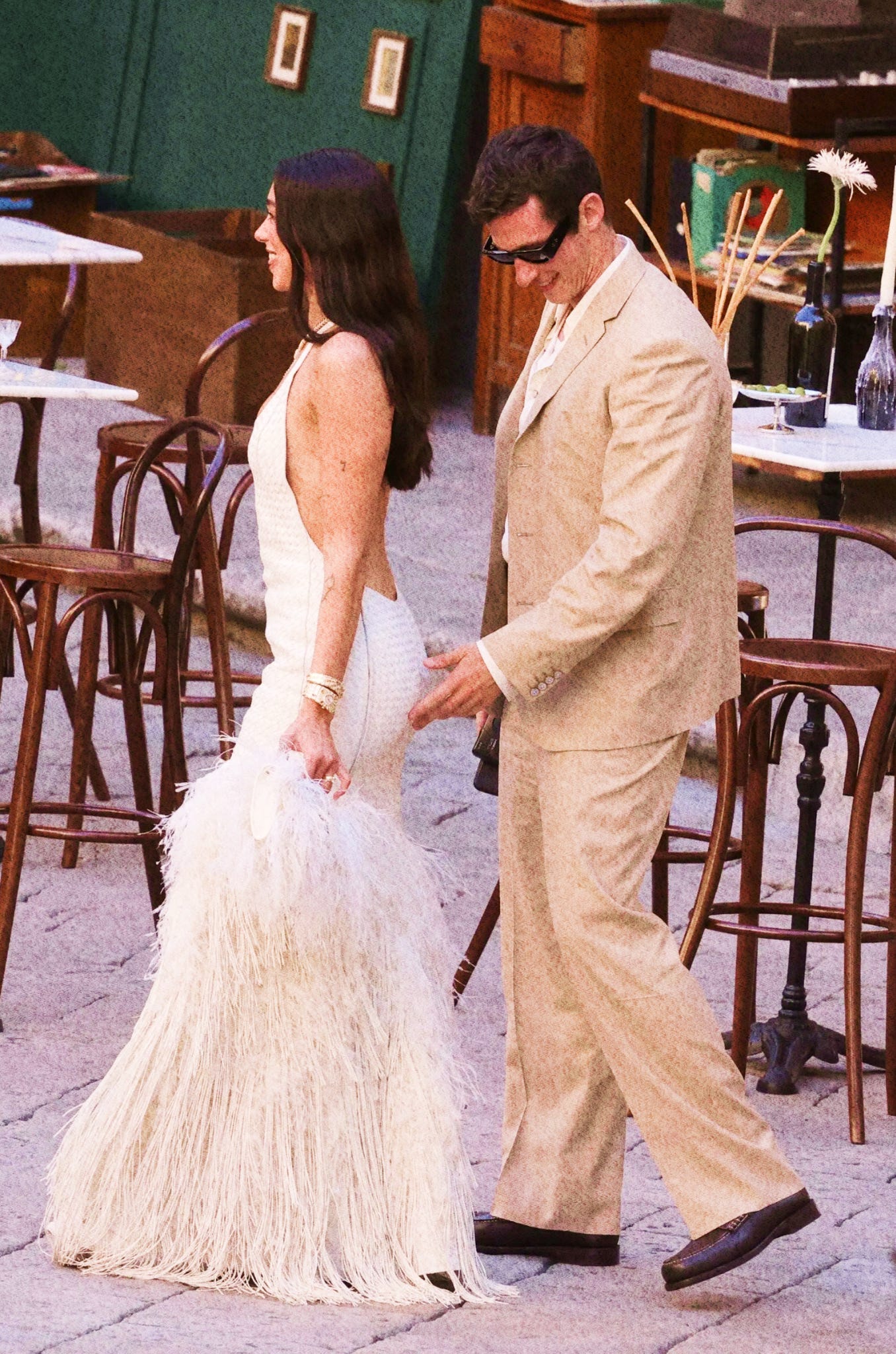
That we’d all like to share in “the system’s spoils” immediately struck me as true, but then again, isn’t more widely sharing in our collective prosperity the point of virtually all projects for redistribution, higher wages, and the like? (The kicker seems to be that the “system’s spoils,” to some degree, always depend on someone else going without.) Does the inconsistency of our objection—that which is reserved for only the most “grotesque manifestations”—suggest that our culture’s issue with “the rich” is less about privilege and more about inhabiting privilege distastefully? Where do you draw the line?
I was originally hesitant to link the article because sometimes the “celebrity who espouses progressive values is not actually blameless” conclusion feels counterproductive; it seems natural that judging values-expressive public figures more harshly than those who appear to stand for nothing beyond their own self-interest just rewards cynicism. I’m also conscious of the tendency to police the behavior of women in this realm more sedulously than that of men.1 Taylor Swift and Lionel Messi are both billionaires; only one is constantly pinned like a butterfly to the board of public scrutiny as the synecdoche for whether it’s ever ethical to be “worth” a billion dollars.
As a specific use case, the response is somewhat understandable: Dua Lipa is a pop star; while the source of her wealth is by no means “pure,” it seems reasonable that wealthy musicians—those who would appear to have derived their fortunes primarily from selling their own talent—would inspire less scorn and generate more defense than a tech CEO who’s become shorthand for labor abuses. Lipa’s fortune is an infinitesimal fraction of Bezos’s. No matter the similarities, they are not the same.
But the core nugget—that our uneven application of outrage might reveal something even more worthwhile about what, specifically, we’re objecting to when we express revulsion at extreme wealth (and, in this case, when we don’t)—will stick with me, unresolved for now.

ATTN: Anyone who’s been procrastinating the “getting your investments organized” song and dance.
If you’ve been meaning to:
Open a new investing account for flexible goals that you can feel confident about consistently contributing to (for a deep dive on why I believe a “non-retirement” investing account is a must, check this out)
Consolidate a bundle of old investing accounts that are scattered here, there, and everywhere so you can keep your money in one, transparent place
Roll over that old 401(k) plan that’s been sitting untouched from two employers ago
…then you should know that Betterment has a new client offer where you can earn up to a $2,000 reward when you deposit or roll over at least $1,000 into a new Betterment investment account. (Just make your deposits within 45 days of account opening to earn your reward!)
Paid client. Views may not be representative. See App Store & Google Play reviews. Learn more. Investing involves risk. Performance not guaranteed. Terms apply.
Betterment is the investment partner for people who want to set their investments on easy mode. With Betterment, you’ll get:
A properly diversified portfolio of index ETFs suited to your risk tolerance and timeline in as little as three minutes
Automated rebalancing, reinvestment of dividends, and tax-loss harvesting, so you don’t have to remember to do any of it
And of course, an easy-to-use interface that doesn’t look like it was created in Windows 1999

It’s embarrassing to admit but I’m sharing in case it helps a similarly ignorant fair-skinned indoor cat: I got fried to a crisp while sitting entirely in the shade of an umbrella this weekend in Santa Fe, what I’ve taken to calling my “ambient sunburn.” Apparently UV rays are “atmospheric” (especially at elevation) so being in the shade doesn’t actually protect you from burning. Truly nothing more humiliating than an adult sunburn; nothing that says “I cannot be trusted to take basic care of myself” quite like it. For the rest of the weekend, I wandered around yelling (read in the same cadence and volume as Ross’s “We were on a break!”) “I was in the shade!” (Allure)

Inflation popped in May for the third straight month—4.2% this time—driven mainly by a staggering 40.5% surge in gas prices. Airfare is up 26.7%. Depending on how long this lasts, travel may become coded as an unmitigated luxury this summer. Maybe we’ll see more emphasis on staycations. (The New York Times)
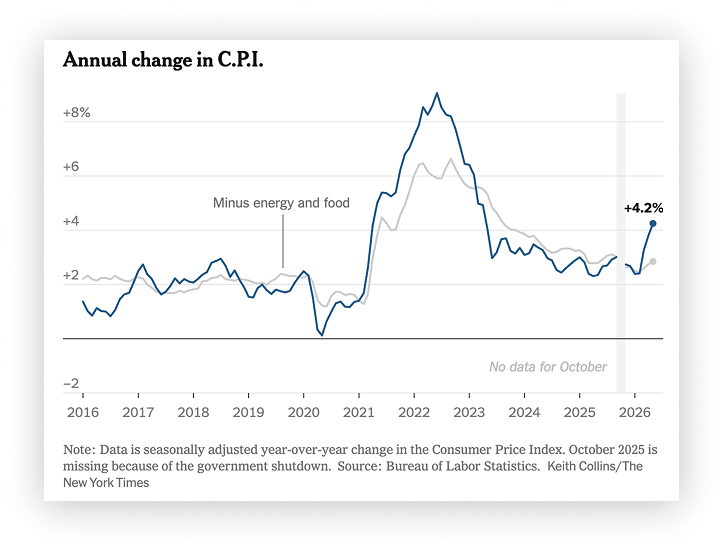
Relatedly, according to this reporting, we’ve all been skating by on an existing surplus of oil reserves, which is the reason why gas prices aren’t even higher despite a 100-day shutdown of the Strait of Hormuz. China, for example, has 1.3 billion just-in-case barrels. Okay, sure. I won’t even pretend to understand the mechanics of this, but will note that everyone seems to have different timelines for when prices will “really” increase. (Wired)
Things might feel unusually bleak because the most press-dominant companies—SpaceX, Palantir, Anthropic, OpenAI—all make product pitches which depend on and foretell the End Times. This novel theory (“American capitalism has taken an apocalyptic turn”) finds that Musk, Thiel, and other dominant American businessmen are just the loudest, most convincing Cassandras, terrifying the rest of us into permitting their personal enrichment. They all foresee imminent doom, like war or mass joblessness or the planet’s uninhabitability, then offer their suggested path forward (data centers, Mars, AI weapons systems) as the one worth investing in. I’d never noticed this similarity between the major players before but I think this theory is onto something. (The Economist)
Lauren Oyler, a woman who will always remain notable and terrifying to me for her willingness to write an evisceration of the universally beloved Trick Mirror, got an AI boyfriend and wrote about it. Whether it was her intention to make LLM companionship sound utterly uncompelling, I’m shocked based on the correspondence she shared that people actually fall in love with their “Replikas.” A characteristically caustic (complimentary) read. (The Yale Review)
Nervous to jinx it but feel obligated to share with Rich Girl Nation that I think I finally found the only natural deodorant that doesn’t make me smell worse after six hours. It runs about twice as much per stick as the popular Native brand ($24 to Native’s $13.99), but if it means I can lift my arms in public after a workout without issuing a county-wide alert, it’s worth the extra $10. (Nécessaire)
Currently reading: Educated by Tara Westover, a memoir about a girl growing up off the grid (I’m only 35 pages in, but it seems fundamentalism and her father’s mental illness are dual culprits) in Idaho. Kept out of school as a kid, the author eventually gets a PhD from Cambridge, but it’s not yet clear to me how. Westover is a poignant storyteller. I know LLMs are a fraught subject so your mileage may vary with this approach, but I asked Claude to make me a ‘reading curriculum’ of books, essays, and other material that explore a theme I’m currently studying for a long-term project, and Educated was a suggestion from “Unit 06: Heretics and Apostates — The Pivot from True Believer.” (Penguin Random House)
This essay about Olivia Rodrigo’s navigation of fame and criticism by writer and musician Eliza McLamb feels so Diabolical Lies-y to me. I loved her explanation of why some women reflexively defend Taylor Swift, even if they don’t particularly like her:
“Women can be touchy about Taylor Swift because she is, very often, our cultural shorthand for ‘women, generally.’ [...] You will notice that there is no cultural shorthand for ‘men, generally,’ because men, generally, are allowed a degree of individuation that does not result in their shortcomings becoming representative of the group as a whole.” (Words from Eliza)

Having a child is the last indissoluble contract, which requires fighting our cultural programming. This A/B experiment between fertility rates in East Germany and West Germany from ethnographer Kristen Ghodsee is worthwhile enough on its own as a history lesson, but there’s something that just feels true about her conclusion that people think twice about having children because the culture our political economy creates actively disincentivizes that sort of decision:
“In the end, all of the arguments about falling fertility rates are also arguments about the incompatibility of capitalist ideals of self-interest and personal wealth accumulation with any altruistic endeavor that requires a long-term commitment. [...]
In societies where personal value is linked to earning capacity, where compensation rates are determined by the fickle fluctuations of supply and demand, workers with primary care responsibilities will always be disadvantaged.” (Jacobin)
Maybe a preoccupation with individual ethics is an impediment to movement-building. Grace Blakeley (most recently: Vulture Capitalism, 2024) has been working on her new book about individualism for almost as long as I’ve known her, and her recent piece on the morality trap (what she calls “moral imperialism”) made me think differently about the role of individual ethics in politics. She argues that our tendency to prioritize a sense of personal moral coherence over a solidarity that recognizes our shared interests is downstream of a neoliberal mindset and redounds to our collective detriment when “[t]he compromises that solidarity requires—the willingness to work alongside people whose values are not identical to your own, toward shared goals that are not perfectly aligned with your own convictions—come to feel like a corruption rather than a necessity.” This one challenged me, in a good way. (Grace Blakeley)
Grazie Sophia Christie, the woman with three first names who penned the viral essay for The Cut a few years ago which made the polarizing case for marrying an older (subtext: richer) man, just got a weekly column writing about celebrity and online culture. I, for one, am thrilled. She’s massively talented and I’m excited to read her work more regularly. Her inaugural offering is about Summer House, a show I’ve never watched. I read every word. (The Point)
And finally, on that note: A new Diabolical Lies episode for subscribers about how reality television is an inherently conservative medium. If you’d like to listen to me infer sweeping political conclusions from Tucker Carlson’s lack of discernible hips on his short-lived Dancing with the Stars stint, look no further.

🤓 Earn up to a $2,000 reward when you deposit or roll over into any individual investing account (including Roth and traditional IRAs) with Betterment. You can get a properly diversified portfolio of index ETFs suited to your risk tolerance, automated rebalancing, and tax-loss harvesting. Get started in as little as 3 minutes.
In that respect, the Bezos <> Lipa contrast is anomalous.
Educated is a fantastic book. Heartwrenching. (You have a long way to go if you're only 45 pages in! Enjoy the journey. Get tissues.)
I'm curious what else was on the list Claude gave you? (And also curious about this project you're researching!?)
Sedulously and synecdoche in one paragraph! I, for one, love the smorgasbord approach of this week’s post.
My immediate reaction to why we found Bezos’s wedding festivities so distasteful vs. Dua Lipa’s was that we are probably just shallow. An old nerd trying to flex with a very plasticky middle aged spouse versus a young, gorgeously talented cool kid pair. 🤷♀️
Regarding the economist article and the men who amass billions by selling doomsday: the single best read for me this year was Infinity Machine, which is nominally about the life of Demis Hassabis but tells you exactly how these dozen or so men have sat in the exact same rooms with the exact same pitches which is why you notice this convergence even from a distance. Our world is run by this single room of men. The book is stunningly good.